

Dispatch from the Desert
Notes on Attention > Devotion > Action
Do stuff. Be clenched, curious. Not waiting for inspiration’s shove or society’s kiss on your forehead. Pay attention. It’s all about paying attention. Attention is vitality. It connects you with others. It makes you eager. Stay eager. - Susan Sontag
I love the desert because it’s a little ugly.
Drop down into the valley and the horizon is a layered cake of brown sediment, four million years in the making. Fault lines crisscross the landscape, geologic activity molds and shapes iconic desert features–badlands, sand dunes, arroyos. But from afar, all you can see is a brown swath of earth, a harsh land with little vegetation, sand-washed granite hills, a dry crust ready to swallow you whole.
To tell you the truth, I went to the desert to dissociate. To make like a lizard and lay on a hot rock in the sun and remind myself that there is something essential to human nature that exists beyond tribalism, materialism, racism, authoritarianism, all the -isms…isn’t there?
But a few days under a fat sun in California’s largest state park isn’t enough to rewire my brain into something equal parts primal and eternal. I wanted the desert to be like Rumi’s field–beyond ideas of wrongdoing and rightdoing–drawing me out from the vortex of our current state of tyranny. The best I could do was put my feet in the dirt, take an edible, and eat chili cheese fries from the local dive bar in town–21st century nervous system regulation.
After driving through the dust-kissed valley and making camp, we continued into the canyon for a sunset hike. Here the desert came zooming into focus. It was no longer a blur of rippled beige earth, but something else entirely. Something alive.


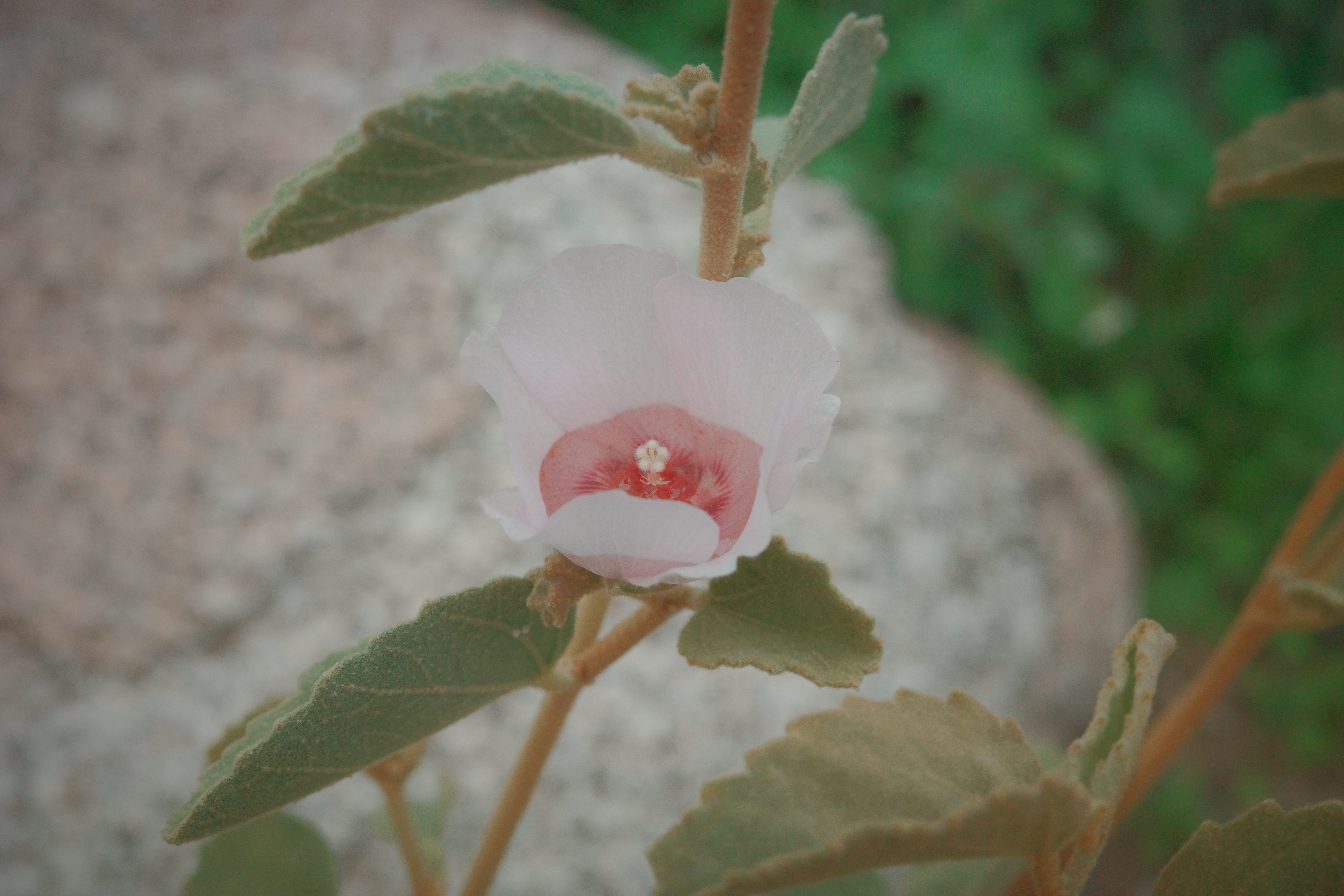
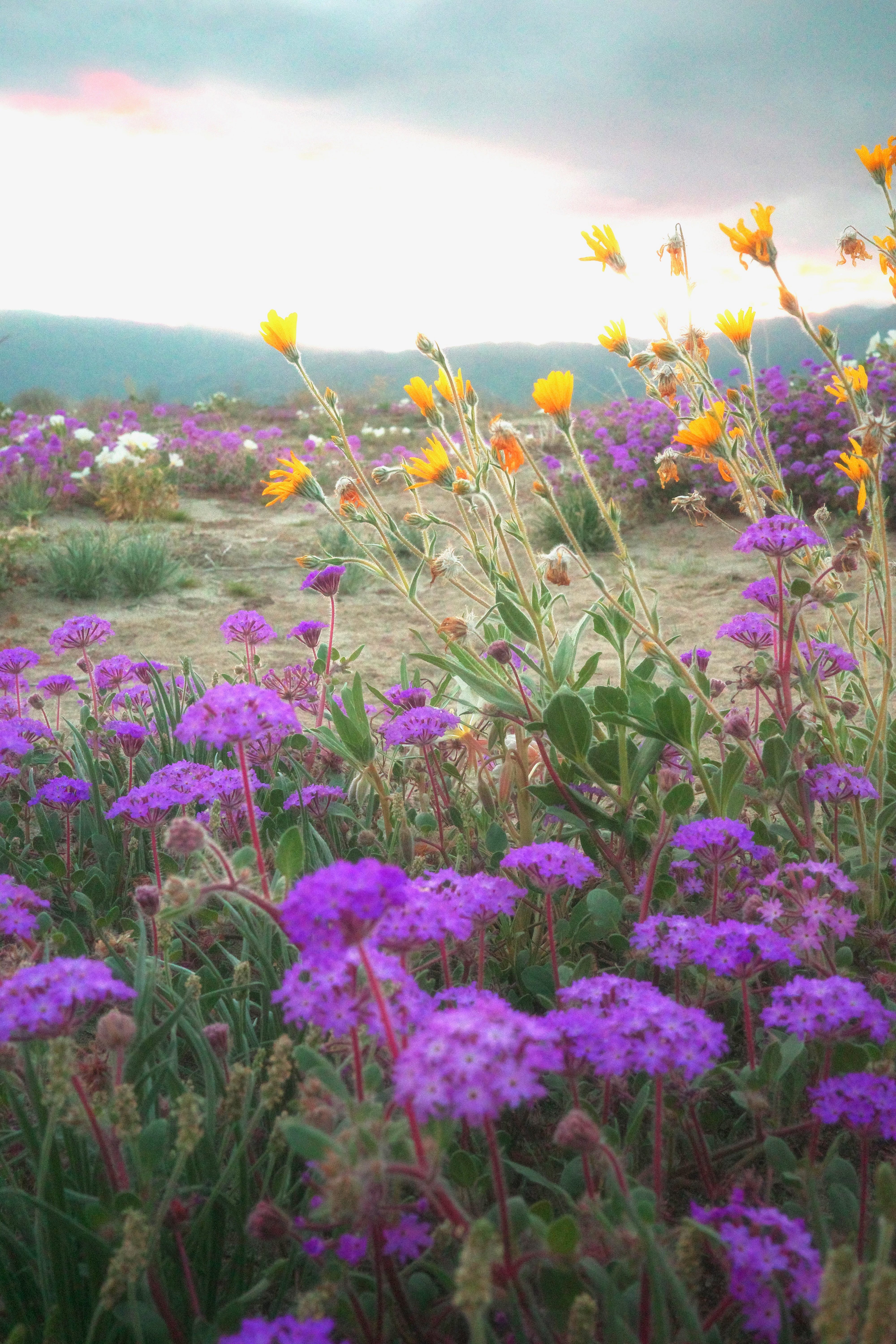
Desert sunflowers spilled into the trail, yellow blossoms teetering on spindly stems. Ocotillo dressed in green, fingertips painted bright red, getting ready to bloom. One particular bush mallow I saw held a small pool of water inside its petals–a cupful of leftover rain. When I tell you about the wildflowers, what I really mean is the desert is so beautiful it hurts a little. You could drive past on the freeway going seventy-five and think to yourself, look at all that nothing. But if that were the case, you wouldn’t see a new hummingbird who only visits after January rains. You wouldn’t learn that there is something called teddy bear cholla, and isn’t it cute that it kind of looks like there’s a small colony of teddy bears standing out there? You wouldn’t squeal at the sight of a kangaroo rat darting across your path in the dark. Or think to yourself the shade of the sky reminds you of strawberry milk. That the moon is kind of like a white sling sitting in the mountain’s saddle. All of this beauty here like a secret, inviting you to pay attention.
At night, stars flood the black desert sky. Anza Borrego is a designated International Dark Sky Place (IDSP), which means there is virtually no light pollution. Without the interference of artificial light, constellations are crisp and clear, visible across the entire sky. The moon, a natural floodlight. The nocturnal environment is enlivened, as evidenced by the soft hoot of a great horned owl, the shrill chord of a pack of coyotes, a shooting star etched across my vision.
It took a while for me to get used to the darkness. I decided to come to the desert in such a rush that I forgot my headlamp, so all I had was my portable reading light with its dim red glow. Being in a dark, quiet environment is a sharp contrast to my regular life, where I live in a dense urban neighborhood, near both a major hospital and fire station–the sound of sirens are so frequent, they’ve become the constant background noise of my life. I’ve become habituated to the sounds of what I consider just a fact of modern life, but in reality, I’ve come to learn that habituation is a myth. While the conscious mind can tune out heavy street noise, it turns out the body can’t. The autonomic nervous system stays in a state of threat detection, monitoring the unpatterned and disruptive soundscape—leading to heightened states of anxiety, even in sleep.
One of my favorite studies on this is titled, “Birdsongs alleviate anxiety and paranoia in healthy participants” studying both traffic noise and birdsong—linking the exposure to birdsong, even just for six minutes, to decreased anxiety, paranoia, and depression. I mean, sounds pretty obvious right!? What’s funny is, despite living in a high traffic noise area, my house is also right on a canyon. My patio is frequently populated by birds–black phoebes, cassin’s kingbirds, hummingbirds, yellow-rumped warblers, western bluebirds, hooded orioles, song sparrows, even red-masked parakeets who come every winter to eat the fruits of a tree in my neighbor’s yard. I live at the intersection of near constant traffic noise, while also in the most bird-diverse city in the U.S. Both are true. Chaos and calm. What’s challenging is focusing my attention to register the bird sounds amidst the thrum of traffic.
Beyond something as seemingly (seemingly!!) benign as traffic noise, it’s far too easy to become habituated to insanity and call it normal—surveillance capitalism, mass shootings, race-based violence, a president having a private army with total impunity executing its own citizens in broad daylight. It is possible to pay attention without habituation. It is necessary to pay attention without habituation.
“Attention is the beginning of devotion,” wrote Mary Oliver. Attention begets devotion. Devotion begets action.
Devotion to the stars leads to consecrating dark sky spaces. Devotion to art leads to waking up an hour earlier to make space to create. Devotion to the dignity of all life leads to standing on the streets to protest and protect your neighbors.
Attention > Devotion > Action
I went to the desert wanting to disassociate, but then I realized that only brings relief for a moment. What actually feels good is paying attention. Birdsong and traffic noise. Desolate landscape and desert sand verbena. Violence and beauty. What actually feels good is doing everything in my power to keep reconnecting to that which is life-affirming so that I don’t become numb and habituated, passive and isolated. To pay attention and then actively choose how to steer my devotion and action is to move the needle toward the kind of world I want to live in, no matter how small the shift.
There’s a chance the desert might get a superbloom later this spring. I love that word so much: superbloom.
California has gotten a lot of rain recently, so wildflowers are pushing up early. When I look out over the desert, it’s hard to believe the millions of seeds down there waiting beneath crumbled soil. It’s hard to believe anything good could happen at all. It’s hard to believe the life that still thrives, the beauty that will gut you the moment you think there’s nothing worth looking at. There’s always something worth looking at.
P.S. Garrett Bucks, a writer I admire is highlighting an Emergency Rental Assistance Fund for Minneapolis families impacted by ICE. They just hit $25,000 and are continuing to raise support. Any amount makes a difference. You can donate here.
P.P.S. I’m resharing an old essay I wrote about my experience as an adult ESL instructor and my fears around Trump’s anti-immigrant agenda back in the fall of 2024. I remain proud of this piece and the conversations it sparked. I hope you’ll give it a read.
One Day We Will All Be Migrants

It’s a Wednesday afternoon. Sunlight rolls through the back windows into the classroom. The city bus’ arrival and departure squeals and murmurs below. I’m circling the still empty room, placing a colorful worksheet on Long U vowel sounds at each table with clipart images of vocabulary corresponding to different spelling structures: oo, ue, ew, u_e.
I just love the way you write, Makayla, and what you have to say. Also, your depictions really made me miss the California desert!
Really beautiful piece on attention as the antidote to numbness. That birdsong study is such a good find, and the irony of living at the intersection of traffic noise and bird diversity isnt lost on me. I live near a busy road too but recently started noticing the cardinals that visit my feeder during rush hour, which totally reframed my mornings. The Sontag quote at the top really ties it togehter.